Same Socket, Different Current: A UK Buyer’s Field Guide to USB-C Charging in 2026
The common charger rules are often described as if they had simplified everything. In practice, they have simplified the shape of the plug, not the economics of the box. Since 28 December 2024, many small and medium electronic devices sold in the EU have been required to use a USB-C charging port and to support USB Power Delivery. From 28 April 2026, the same approach has applied to laptops. Sellers must also let buyers choose whether to take a charger, and must give clear information about charging. None of that means every device arrives with the right cable, or that the charger already in your cupboard will run it at full speed.
For UK buyers, the picture is more uneven. Great Britain has not adopted an equivalent statutory common charger requirement, although Northern Ireland’s goods rules can diverge. A device sold in the UK may therefore have a USB-C port because the manufacturer has designed it for the European market, without the same legal assurances about box contents or charger unbundling. The result is familiar: a new phone, tablet or laptop arrives, and the household cable drawer becomes the first place to look for a working connection.
What the rules do — and do not — settle
The rules are best understood as a settlement about the port, not a promise about performance. They reduce the number of charging connectors a buyer has to recognise, and they make USB Power Delivery the common language for many devices. They do not create one universal charger for every product. A phone may ask for 25W, a tablet for 45W and a laptop for 100W or more. The plug can look identical while the current behind it is very different.
The rules also do not cover every device. Some accessories, older products and specialist equipment fall outside the scope. Nor do they guarantee that a cable is included. The choice to sell a device without a charger is permitted in the EU, provided the buyer is informed and offered a separate option. In the UK, where the same legal duty does not apply, the box can be even less predictable: a charger may be present, absent, or replaced by a short cable of unknown capability.
That is why the useful question is not whether a product is USB-C compliant. It is whether the product, the charger and the cable form a complete system for the way you intend to use it.
The drawer is a power grid, not a tangle
A cable drawer usually contains three kinds of object: known-good charging cables, unknown cables kept just in case, and cables that should have been recycled years ago. A practical audit begins by separating them.
First, divide USB-C to USB-C cables from USB-A to USB-C cables. The latter can be useful for low-power accessories, but they will not deliver the higher power levels many modern laptops and tablets expect. A USB-A charger is unlikely to support USB Power Delivery at the level a device needs.
Second, read the markings. Many cables are printed with a wattage or current rating, such as 60W, 100W or 5A. Some newer cables support 240W Extended Power Range, but only if the charger and device also support it. A cable with no marking is not necessarily unsafe, but it is an unknown quantity. For expensive equipment, unknown is rarely a good default.
Third, note that charging and data are separate capabilities. A thin cable that charges a phone may carry data slowly or not at all. It may not support video output to a monitor or a dock. The common charger rules do not make every USB-C cable a data cable, and they do not make every cable suitable for a display.
Fourth, inspect condition. Cables with exposed conductors, bent connectors or loose fit should be retired. UK households can take small electronic waste to local recycling centres, and many retailers operate collection points. Keeping a damaged cable in the drawer does not create a spare; it creates a future fault.
A simple labelling system helps. Keep two known-good sets: one for travel and one for the desk. Mark the wattage on the connector end with a label or a small tag. The aim is not an elegant drawer. It is a drawer that answers a question in seconds.
The empty-box calculation
A charger-less box can be a genuine saving. If you already own a USB Power Delivery charger and a USB-C to USB-C cable rated for the device’s maximum charging speed, the lower price is money kept. This is often true for households that have bought a good multi-port charger in recent years.
It becomes a hidden cost when the device needs more than your existing charger can supply, or when it relies on a proprietary fast-charging standard that your charger does not support. A 30W charger may keep a laptop running, but it may not charge it quickly while the screen is on. A cable rated for 60W may be fine for a phone and inadequate for a larger machine. The saving disappears once a compatible charger and cable are added back into the basket.
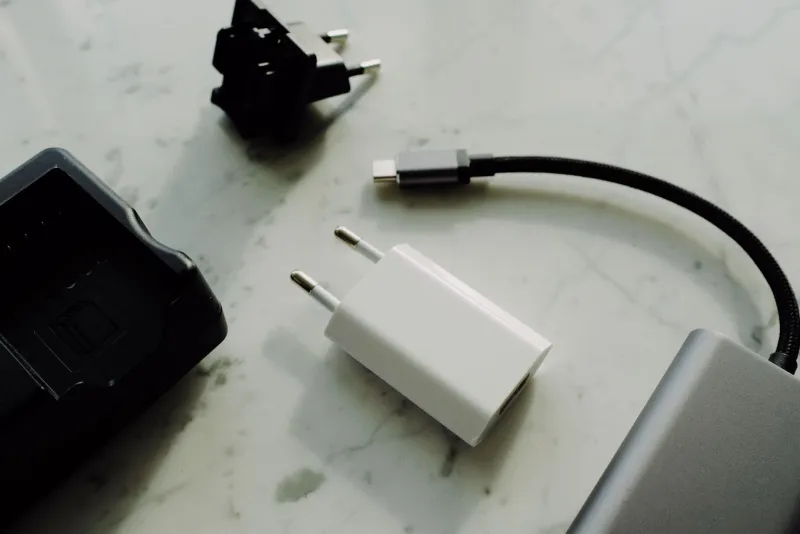
The calculation should include the UK plug. A charger with a European plug may need an adapter for daily use, which is inconvenient and can be a safety compromise if the adapter is poor quality. A UK three-pin charger is the better comparison point.
Buyers should also check the return window. If the box arrives with no charger and no suitable cable, the cost of returning the item may outweigh the saving. A quick look at the product page, the specification sheet and the reviews can reveal whether a charger is included. Where the information is unclear, treat the charger as absent and budget for one.
Before you buy: five checks
First, confirm the charging port. USB-C is now common, but some devices still use other connectors, and some USB-C ports are data-only.
Second, find the charging wattage. Look for the maximum supported input and, where possible, the minimum required to charge at a useful rate. A laptop that ships with a 65W charger may accept 100W, but it may charge slowly on 30W.
Third, read the box contents. Check whether a charger, a cable, both or neither are included. If a cable is included, check its rating. A short cable rated for 60W is not a substitute for a 100W cable on a larger laptop.
Fourth, check the protocol. USB Power Delivery is the common standard, but some phones and accessories use proprietary fast-charging methods. A standard charger may still work, but perhaps only at a slower speed.
Fifth, consider the accessory. Headphones, watches and small devices may not need a charger in the box, but they may need a cable you do not own. The same audit applies at a smaller scale.
A sensible household routine
The common charger rules are a useful step towards less waste and fewer incompatible plugs. They are not a guarantee that every purchase will be complete. For UK buyers in 2026, the practical defence is a short annual audit: sort the drawer, label the known-good cables, recycle the damaged ones and check the box before buying.
A charger-less box is neither a scandal nor automatically a saving. It is a procurement decision. If the device, charger and cable match, the empty box is efficient. If they do not, the cost simply moves from the basket to the cable drawer — or to the next order.